Give the courtyard time
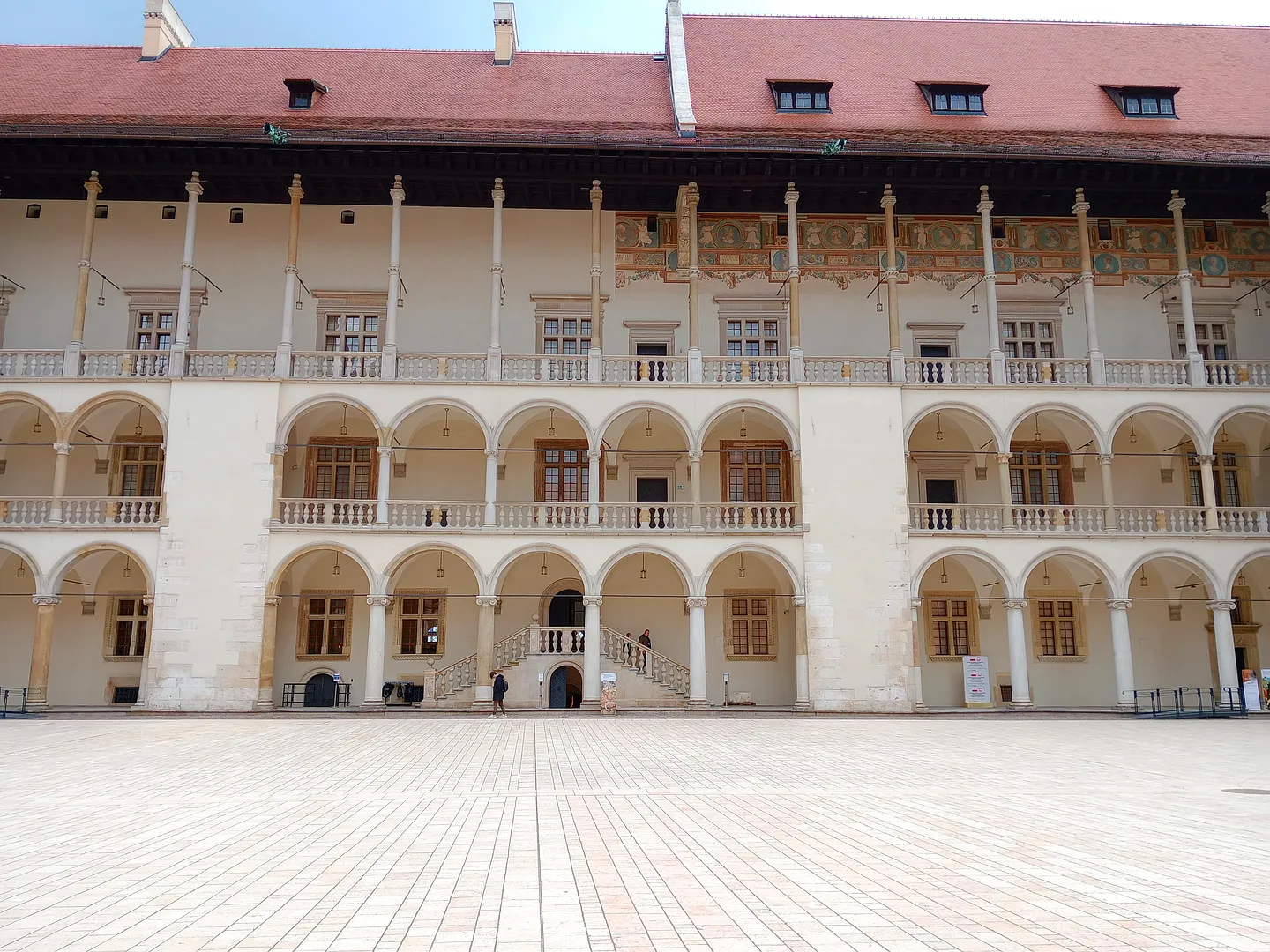
At Wawel, we find ourselves looking up. The arcaded courtyard has rows of arches to follow around its corners, and it is easy to spend a few minutes noticing how the upper galleries sit above the open space. We like allowing time for that kind of pause before deciding which doorway or path comes next.
Our photographs from 14 and 18 April 2024 follow the approaches, courtyard and grounds of Wawel Hill. They show the spaces between the museum visits: brick walls beside a walkway, planting near the buildings and the river below. If those are the details you enjoy, leave room for them around the exhibition times you book.
How Wawel became the castle we see today
A stone residence stood on Wawel by the middle of the eleventh century. In the fourteenth century, Władysław I Łokietek and his son Kazimierz III Wielki expanded the Gothic castle. Wawel was a residence of Poland’s Piast rulers and, later, the Jagiellonian dynasty.
King Alexander I commissioned Renaissance rebuilding around 1504. His brother Sigismund I the Old continued it from 1507, employing artists including Francesco Fiorentino and Bartolomeo Berrecci. The palace and arcaded courtyard were completed around 1540. These are the galleries we follow with our eyes in the courtyard photographs.
A fire in 1595 led Sigismund III Vasa to rebuild part of the northern wing in the early Baroque style. The royal court settled permanently in Warsaw around 1610, leaving Wawel for occasional royal visits and ceremonies. Another fire damaged the castle in 1702.
Following the partitions of Poland in the late eighteenth century, Wawel came under Austrian military control. The royal rooms became barracks, some buildings on the hill were demolished and fortifications were added. Austrian troops withdrew between 1905 and 1911. Restoration began under Zygmunt Hendel and continued under Adolf Szyszko-Bohusz; after Poland regained independence in 1918, the castle was adapted for a museum and presidential residence. The restoration was still unfinished when the Second World War began.
The museum was established in 1930. During the German occupation, Hans Frank, governor-general of occupied Poland, used the castle as his residence. Conservation continued after the war, restoring rooms and buildings for museum use.
Today Wawel is a restored historic residence and museum with exhibitions in its rooms and archaeological remains beneath parts of the complex. Some original Renaissance stonework removed during conservation is displayed in The Lost Wawel exhibition, while replacement pieces remain in the courtyard. We’d add that exhibition to a visit if the arches make us curious about the older fabric of the building. The courtyard we photograph has survived through rebuilding and repair across several centuries.
Choose the museum visit you actually want
Wawel’s castle museum has several exhibitions and routes, with their own visiting arrangements. Start on the official visitor page, choose what interests you and check the available times before fixing the rest of your Kraków day. Daily visitor limits apply. We’d pick the collections we most want to spend time with and leave enough room between entries to find the next entrance without rushing.
The museum’s FAQ gives approximate visiting times of about 40 minutes for the Crown Treasury and 60 minutes for the Castle First Floor. Those are useful planning figures, with extra time needed for moving between entrances or stopping in the courtyard. Exhibitions and seasonal routes can change, so use the current listings when choosing tickets.
Wawel Cathedral has separate visitor arrangements. The castle museum does not sell tickets for the cathedral, Royal Tombs, Sigismund Bell or Cathedral Museum. If the cathedral is part of your plan, check its own website as well. Our gallery includes exterior views of it from the hilltop walk.
Walk up with the entrance in mind
The castle is on Wawel Hill at the southern end of Kraków’s Old Town. Its directions page puts it about a ten-minute walk from the Main Market Square. We’d take longer if following Grodzka Street gives us a reason to stop, and allow extra time for the climb and finding the entrance shown on our ticket.
Wawel and Stradom are nearby tram stops. If arriving by bicycle, leave it at the racks beside the entrance gates: bicycles are not permitted on the hill. For a car visit, the official directions list the underground garage at Plac na Groblach as about five minutes away on foot. Check parking and transit information for the day you travel.
- Save your tickets and the official hill map before arriving.
- Check the entrance for each booked exhibition.
- Plan cathedral admission separately from castle museum tickets.
- Contact the museum in advance if you need help with access.
Leave room for the river view
We like ending a walk around the buildings with a look towards the Vistula. In the April photographs, the river opens out beyond the walls and the spring trees along the bank. It gives the outing a place to pause before returning to the streets of the Old Town.
The paths include slopes and steps, as the photographs show. If you use a wheelchair or need a route with fewer steps, discuss the exhibitions and approach with the museum in advance. Its accessibility page describes available arrangements; one photograph of a level courtyard cannot tell you what the whole visit will involve.
Planning sources
Visitor conditions and schedules can change. Check these official sources before travelling.
- Wawel Royal Castle: exhibitions and visitor information
- Wawel Royal Castle: tickets and visiting-time FAQ
- Wawel Royal Castle: directions and transport
- Wawel Royal Castle: map of the hill
- Wawel Royal Castle: accessibility
- Wawel Cathedral: separate visitor information
- Wawel Royal Castle: history of the hill, royal palace and museum
- Wawel Royal Castle: military occupation and restoration in Wawel Recovered
- Wawel Royal Castle: archaeological remains and original stonework in The Lost Wawel
Source links checked September 30, 2026.