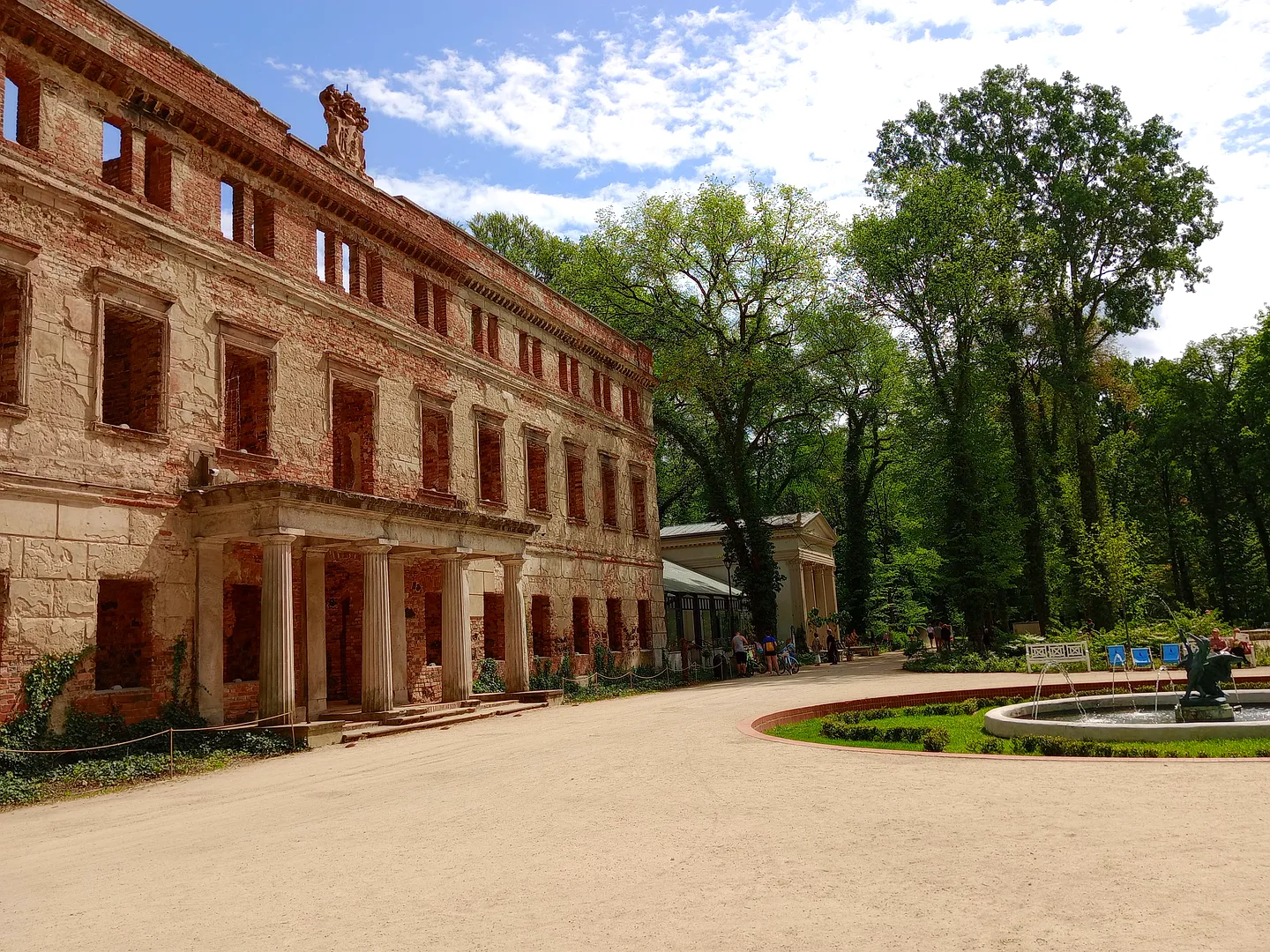
Begin beside the palace
Zatonie suits the way we like to spend a day outdoors: a place to start, then enough freedom to follow a path that looks inviting. We’d begin beside the palace. The columns give the façade its shape, while the exposed brick and empty openings invite a closer look. There is time to notice those details before heading into the trees.
This is Park Książęcy w Zatoniu, in a district of Zielona Góra in western Poland. The palace and park grew over several centuries, with major nineteenth-century changes associated with Dorota de Talleyrand-Périgord, the Duchess of Dino. The National Institute of Cultural Heritage records the park’s revitalisation in 2018–2020, with the complex returned to use in October 2020. That date helps make sense of the older photographs in our collection.
The people and years behind Zatonie
The palace began as a Baroque manor built in 1685–1689 for the estate’s owner, Balthasar von Unruh. Frederika Christiana Cosel owned the estate from 1771 to 1784 and altered the house. In 1809 it passed to Dorota Biron, later Dorota de Talleyrand-Périgord, the Duchess of Dino. Her rebuilding in 1842–1843 gave it the neoclassical form visible in the surviving façades.
An ornamental garden existed here in the eighteenth century. The larger landscape park began taking shape in the 1840s under Dorota, extending across about 32 hectares. Its layout included the broad Joanna Meadow, a pond with Maria Island and a viewing mound with a pavilion above a stone grotto. Those features give us things to look for as we leave the palace and follow the paths into the grounds.
When Dorota died in 1862, her son Alexander Edmund de Talleyrand-Périgord inherited the estate. Karl Rudolf Friedenthal bought it in 1879, and his daughter Renata von Lancken-Wakenitz held it from 1890 until 1945. Renata added about 18 hectares of woodland to the park before 1905. In 1945 Soviet troops burned the palace and orangery, leaving the residence in ruins.
After the war, the park passed to the State Forests. Zielona Góra leased the complex in 2017, and work secured the palace walls and restored the grounds. The park’s revitalisation ran from 2018 to 2020; the complex reopened on 15 October 2020. Today the palace remains a roofless ruin, with its columned porticos and surviving walls visible from the paths. The orangery has been rebuilt and houses a café. We like having that history in mind when looking between the exposed brick of the palace and the restored building beside it.
Let the paths take some of the afternoon
The palace is a useful starting point for a walk through the 52-hectare park. We like following the broad avenues into the wooded areas, then coming back towards the open lawns. In our May photographs, the pale gravel paths stand out against the green ground beneath the trees. The small pavilion above the grotto is another reason to stop and look around.
Use the official park map to choose a walk that fits your group. It shows the palace, ponds and the Rose Temple, so you can decide how far to go before leaving the central area. We’d keep the plan loose enough for a pause at the fountain or a closer look at a building. A photograph gives a reason to stop; it should also leave the path clear for the people walking past.
Get the arrival and facilities sorted
Visit Zielona Góra lists free, round-the-clock access to the park and palace ruins. The visitor information point is at Zatonie – Księżnej Doroty 3, with parking nearby. Its published arrival guidance names the Zatonie Parkowa bus stop beside the western entrance and a paved cycling connection from Zielona Góra. Check the current MZK journey information before relying on a particular bus departure.
The café in the former orangery can be a useful place to plan a break. Check its hours separately from the park’s access. Toilets are in the orangery and visitor information building; the information-point toilet is available during that building’s opening hours. Dogs are allowed on a leash. If step-free access matters, ask the visitor information team about the paths you intend to use, as well as the accessible facilities they list.
- Save the official park map before setting off.
- Check visitor information and café hours if you need their facilities.
- Keep to the open paths and respect barriers around the ruins.
- Choose shoes for gravel paths and the weather on the day.
Look at the dates as well as the views
Our collection includes visits from November 2018 through May 2024. Bare trees give a clearer view of some buildings; the spring photographs bring the paths and planting into the foreground. We enjoy being able to compare those views. The 2018 photographs also show the ruins before the revitalisation was completed, so they belong alongside the later images with their dates visible.
The gallery is a selection from those visits. We’d use it to choose the details you want to look for, then check the official visitor page for the practical arrangements for your own day in Zatonie.
Planning sources
Visitor conditions and schedules can change. Check these official sources before travelling.
- Visit Zielona Góra: access, arrival and facilities
- Visit Zielona Góra: history of Zatonie Ducal Park
- National Institute of Cultural Heritage: Zatonie palace complex
- Visit Zielona Góra: downloadable park map
- MZK Zielona Góra: current public transport timetable
- National Institute of Cultural Heritage: origins, layout and restoration of Zatonie park
- Przytok Forest District: Zatonie’s estate history
- Visit Zielona Góra: the palace ruins and rebuilt orangery today
Source links checked September 30, 2026.