A reason to pause here
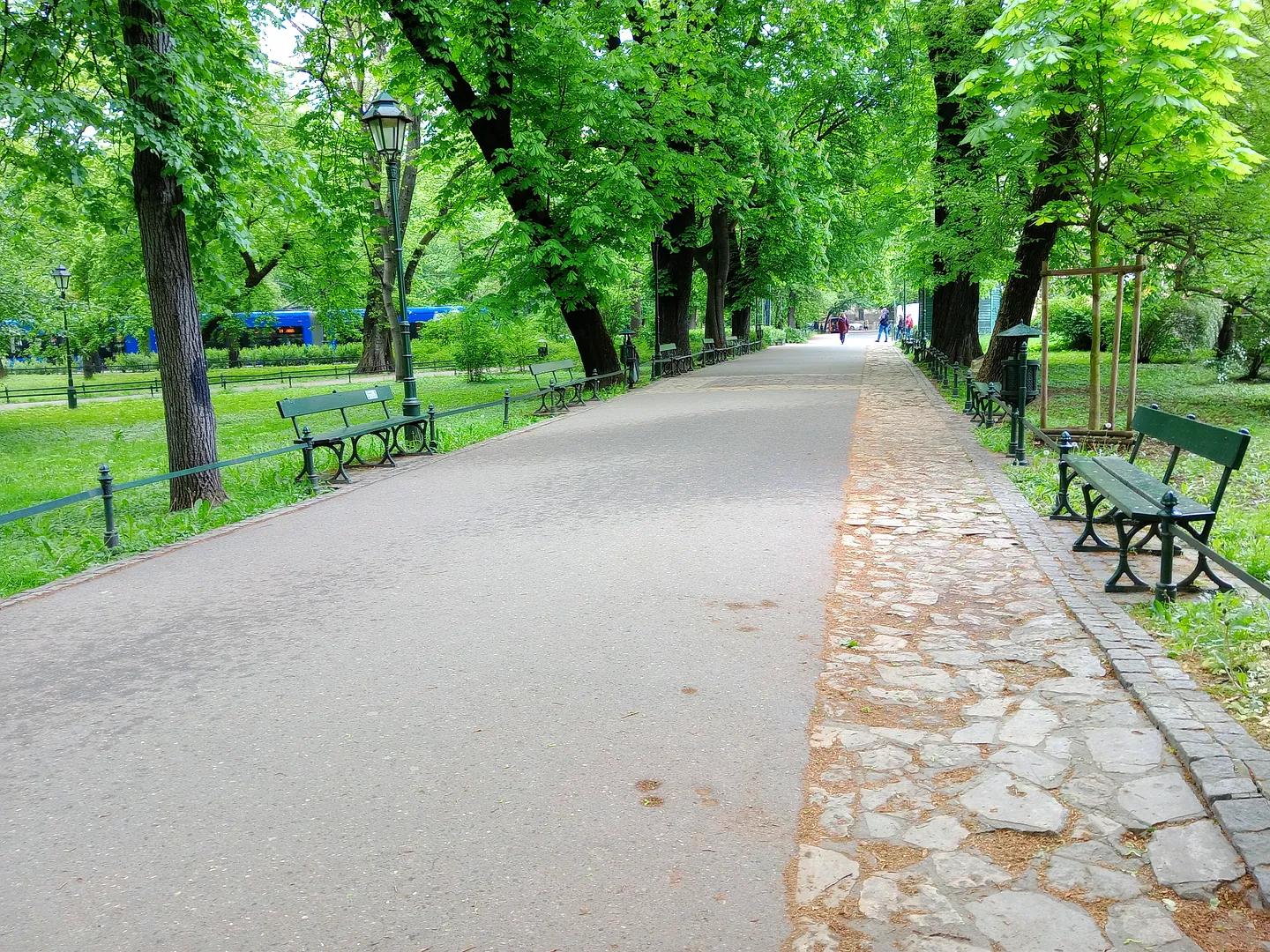
The straight avenue gives us room to slow down between Wawel and the city streets; flower beds and small monuments reward leaving the quickest route.
From defences to a planted ring
Kraków laid out the Planty in the early nineteenth century on land released by the removal of much of the medieval fortifications. Feliks Radwański proposed the garden, and Florian Straszewski carried the work forward. Filled moats, new avenues and planting created the park around the Old Town.
The Wawel Garden belongs to that larger ring, now divided into eight gardens over roughly four kilometres. Later benches, flowerbeds and monuments gave individual stretches their own details. We would use the whole-ring history to orient the walk, then look closely at this southern section.
Take the avenue at a slower pace
Our spring photographs follow the straight avenue, benches and planted beds. We would begin with the park information board, then choose a path that leaves time for a monument or a pause under the trees. The main route is useful, but it need not be the only line we follow.
The garden pairs naturally with an approach to Wawel. If museum entries are booked, keep the park walk before or after them flexible rather than treating it as another timed appointment.
Plan the visit
The Planty is a public park around the Old Town. Use the current city park and public transport information for closures or changed approaches. Paths shown level in one photograph do not establish that the onward Wawel route is step-free; plan the hill and museum entrances separately. Keep shared avenues clear when stopping for photographs.
- Use the garden board to choose a comfortable stretch.
- Plan the climb to Wawel separately from the park walk.
Planning sources
Visitor conditions and schedules can change. Check these official sources before travelling.
Source links checked September 30, 2026.